
The government has issued Executive Order No. 130, which sets new rules for suspending and resuming face-to-face classes, school activities, and on-site work in schools and learning centers.
President Ferdinand R. Marcos Jr. signed the order on October 28, 2026. It aims to protect learners, teachers, and school personnel during natural disasters and other emergencies. It also helps schools make decisions based on official warnings and local conditions while keeping learning activities going.
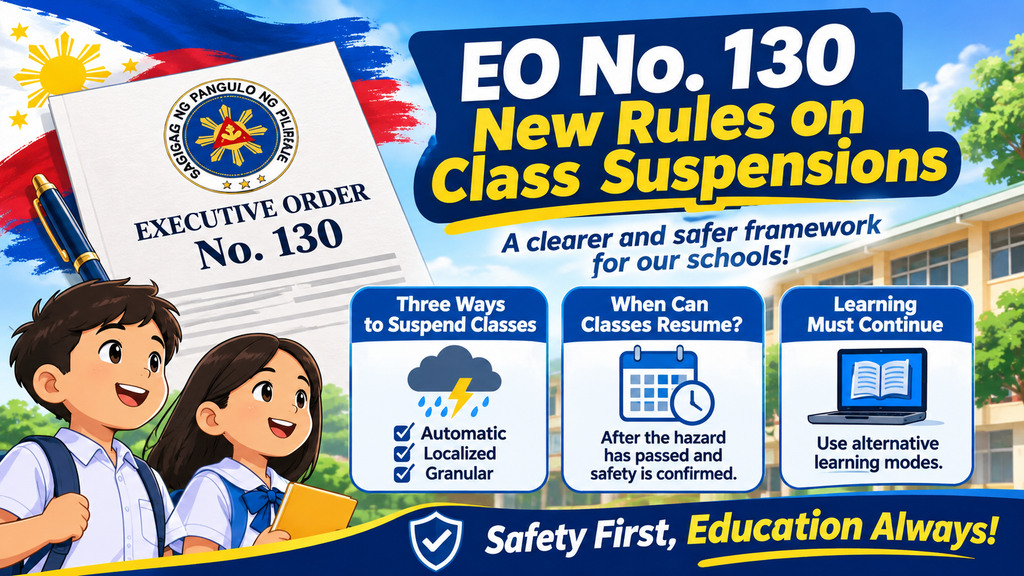
Three Ways to Suspend Classes
Under EO No. 130, authorities can suspend face-to-face classes and on-site work through three mechanisms.
1. Automatic Suspension

Automatic suspension takes effect when PAGASA, PHIVOLCS, DENR-EMB, or another authorized government agency issues an official warning, advisory, alert, or forecast that meets the required conditions.
In this case, authorities do not need to issue a separate suspension announcement.
2. Localized Suspension
Governors and mayors can suspend classes and on-site work in their areas based on local conditions and risk assessments.
Their announcements must clearly state the areas covered and the suspension period. They must also coordinate with barangay officials, schools division superintendents, and private school heads when necessary.
3. Granular Suspension
Schools and learning centers can also suspend classes and on-site work if they identify an actual or possible threat to the safety and health of learners and personnel.
However, schools can only use this option when no automatic or localized suspension is already in effect.
When Can Classes Resume?
EO No. 130 also explains when schools can resume face-to-face classes, school activities, and onsite work.
For automatic and localized suspensions, classes generally resume when the suspension period ends or when the government agency lifts, downgrades, or expires its warning or advisory.
Schools must also complete the required safety inspections before resuming classes.
During a localized suspension, a school may request to resume classes earlier than the announced date. However, it needs the approval of the concerned local chief executive.
Before resuming classes, schools must assess their actual conditions and make sure that the danger has passed or that they have addressed the risks. They must also consider whether learners, teachers, and other personnel can safely travel to and from school.
Learning Must Continue During Class Suspensions
Suspending face-to-face classes does not mean that learning must stop.
Whenever possible, schools must continue teaching through appropriate learning delivery methods. They must follow the policies of DepEd, CHED, TESDA, the ECCD Council, and other concerned agencies.
Schools may use alternative learning delivery modes during class suspensions to help learners continue their studies.
Roles of Government Agencies
EO No. 130 also identifies the responsibilities of different government agencies:
- DepEd – Leads and monitors the implementation of the order.
- DILG – Coordinates with local government units (LGUs) and monitors their compliance.
- PAGASA, PHIVOLCS, and DENR-EMB – Provide official warnings, advisories, and information about possible hazards.
- DPWH – Assesses school buildings and other affected facilities after disasters and emergencies.
These agencies will work together to help schools and local authorities make decisions during emergencies.
Implementing Guidelines and Effectivity
DepEd, together with CHED, TESDA, DOST, PAGASA, PHIVOLCS, DENR-EMB, DILG, DPWH, and other concerned agencies, must issue the implementing guidelines within 30 days from the effectivity of the order.
These guidelines will explain the technical requirements, suspension rules, required documents, timelines, and coordination procedures.
EO No. 130 also amends Executive Order No. 66, series of 2012, particularly its provisions on suspending face-to-face classes, school activities, and on-site work in educational institutions and learning centers.
The order takes effect immediately after its publication in the Official Gazette or in a newspaper of general circulation.
What This Means for Schools and Learners
Under EO No. 130, authorities and schools will follow three ways to suspend classes: automatic, localized, and granular suspension.
Schools must also check actual conditions before resuming face-to-face classes and on-site work.
Most importantly, the suspension of face-to-face classes does not automatically stop learning. Schools must continue providing learning activities whenever possible.
With these new rules, schools, local government units, and concerned agencies will have clearer procedures for handling class suspensions and ensuring the safety of learners and school personnel during emergencies.