
Planning your vacation or your workload? You might need to know the list of holidays in the country to plan it perfectly. It is important to know the official holidays and special non-working days in the Philippines for 2026, especially for learners. In this post, we’ve compiled the complete list of regular holidays, special non-working days, and potential long weekends based on the government’s official proclamations. Thus, this list of holidays will help you plan your leave, trips, and family time wisely.
Holidays play an important role not just as days of rest but also as moments to celebrate our history, culture, and faith. Whether it’s time spent with family, religious observance, or a well-deserved break from work, holidays help promote well-being and national unity. This official list of regular holidays and special non-working days in 2026 is based on Proclamation No. 1006, s. 2025. We have added the list of holidays and special non-working days in both national and local declarations.
Walang Pasok: November 16-18, 2026
Classes and work in the National Capital Region (NCR) may be affected from November 16 to 18, 2026, as the country hosts activities related to the 49th ASEAN Summit. The schedule may lead to adjustments in classes, work arrangements, and other activities in Metro Manila.
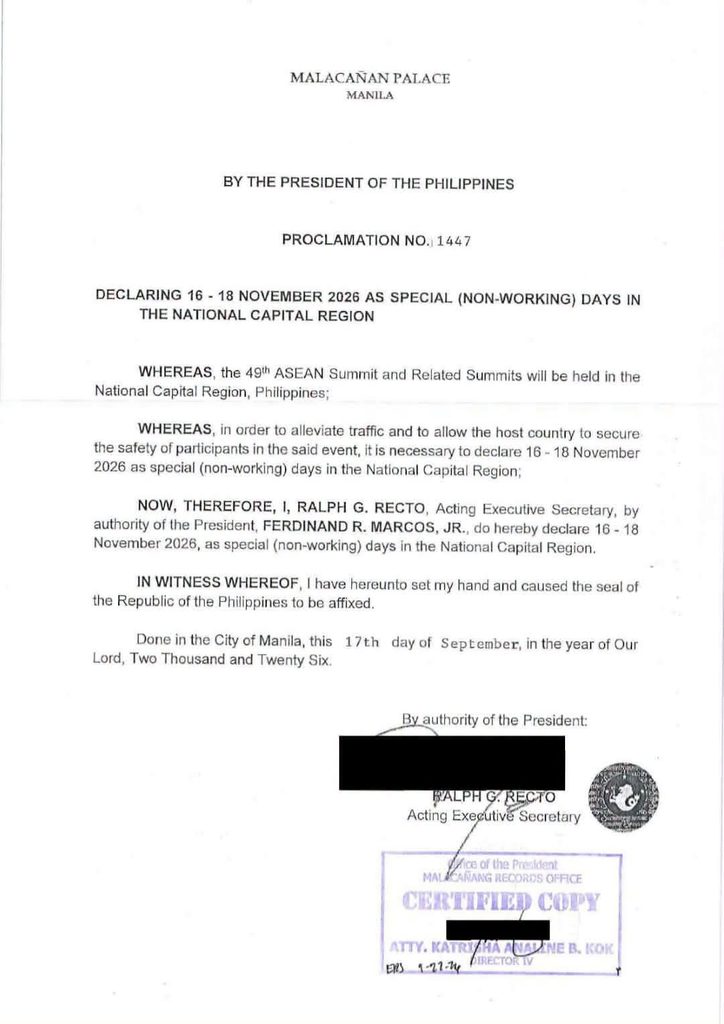
Students, parents, teachers, and employees should check the announcements from their LGU, school, or office for the specific coverage and learning or work arrangements. Since local directives may differ, it is important to wait for the official announcement before assuming that classes or work are suspended.

Local Special Non-working Day (by Proclamation)
A Local Special Non-Working Day applies only to a specific city, municipality, province, or other area named in a presidential proclamation. The government usually declares these days to give residents time to celebrate important local occasions, such as founding anniversaries, cityhood anniversaries, or festivals.
- October 8, 2026 – San Isidro, Surigao del Norte: Special non-working day for the municipality’s 67th founding anniversary (Proclamation No. 1468).
- October 12, 2026 – Talisay, Batangas: Special non-working day to commemorate the Battle of Batangas (Proclamation No. 1466).
- October 16, 2026 – Lapuyan, Zamboanga del Sur: Special non-working day for its 69th founding anniversary (Proclamation No. 1469).
- October 20, 2026 – Batac, Ilocos Norte: Special non-working day for the 160th birth anniversary of Gen. Artemio Ricarte (Proclamation No. 1470).
- October 21, 2026 – Sibutu, Tawi-Tawi: Special non-working day for its founding anniversary (Proclamation No. 1471).
- October 23, 2026 – Angeles City: Special non-working day for the Tigtigan Terakan Keng Dalan Festival (Proclamation No. 1472).
- October 23, 2026 – Narvacan, Ilocos Sur: Special non-working day for the observance of Aldaw Ti Wayawaya-lli A Narvacan (Proclamation No. 1473).
- October 28, 2026 – Dingle, Iloilo: Special non-working day commemorating the Cry of Lincud, the first declaration of revolution against Spain in Iloilo province and Panay (Proclamation No. 1474).
- October 29, 2026 – Mati City, Davao Oriental: Special non-working day for the Sambuokan Festival (Proclamation No. 1475).
For September 2, 2026, the observance of Simeon Ola Day applies to the Province of Albay. Whether it is a non-working holiday or involves suspension of classes and work depends on the specific law or official issuance governing the observance. Employees, teachers, students, and other stakeholders in Albay are encouraged to check announcements from their respective local government units, schools, offices, and relevant government agencies for the applicable arrangements and any special guidelines for the day.
List of Holidays and Special Non-working Days in 2026
The Office of the President issued the list of official holidays and special non-working days for the year 2026 on September 3, 2026. This list contains 10 regular holidays and 8 special non-working days. As in previous years, the EDSA People Power Revolution Anniversary was celebrated on February 25 (Tuesday) and declared a special working day.
| Date | Holiday | Remarks |
|---|---|---|
| January 1 | New Year’s Day | Regular Holiday |
| February 17 | Chinese New Year | Special Non-Working Day |
| April 9 | Araw ng Kagitingan | Regular Holiday |
| April 2 | Maundy Thursday | Regular Holiday (Holy Week) |
| April 3 | Good Friday | Regular Holiday (Holy Week) |
| April 4 | Black Saturday | Special Non-Working Day (Holy Week) |
| May 1 | Labor Day | Regular Holiday |
| June 12 | Independence Day | Regular Holiday |
| August 21 | Ninoy Aquino Day | Special Non-Working Day |
| August 25 | National Heroes Day | Regular Holiday (Last Monday of August) |
| November 1 | All Saints’ Day | Special Non-Working Day |
| November 2 | All Souls’ Day | Special Non-Working Day |
| November 30 | Bonifacio Day | Regular Holiday |
| December 8 | Feast of the Immaculate Conception of Mary | Special Non-Working Day (Religious Holiday) |
| December 24 | Christmas Eve | Special Non-Working Day (Commonly Observed) |
| December 25 | Christmas Day | Regular Holiday |
| December 30 | Rizal Day | Regular Holiday |
| December 31 | Last Day of the Year | Special Non-Working Day |
Difference Between Regular Holidays and Special Non-Working Days
The regular holidays and special non-working days differ mainly in their legal basis, national importance, and observance. The law mandates regular holidays to commemorate significant historical, cultural, or religious events, such as Independence Day. Employers must give these as compulsory days off, unless the workplace requires continuous operations. In contrast, the president often declares special non-working days to honor regional or cultural events such as Ninoy Aquino Day, All Saints’ Day, or Christmas Eve. These days may be flexible and can vary with each administration.

Another key difference lies in how employers treat these holidays. Regular holidays are treated as mandatory rest days, and employees who do not work on these days are still entitled to receive 100% of their daily wage. On the other hand, special non-working days typically follow a “no work, no pay” policy—unless company rules or collective bargaining agreements state otherwise. Employers offer higher pay and enforce regular holidays more strictly than special non-working holidays in both the public and private sectors, especially when employees render work.
Regular Holiday vs Special Non-working Day vs Special Working Holiday
A regular holiday commemorates events of national significance, and employers pay workers even if they do not report for work; those who report receive double pay. A special non-working day honors cultural, historical, or local events, and employers apply the “no work, no pay” rule. However, they give employees who work an additional 30% of their daily wage. For government employees, the Civil Service Commission (CSC) ensures they still receive their regular salary during special non-working holidays, even if they do not report for work. Meanwhile, a special working holiday observes an event rather than providing a day of rest, and employers treat it like an ordinary working day with no extra pay.
| Scenario | Regular Holiday | Special Non-Working Day |
|---|---|---|
| If the employee does not work | 200% of daily wage | 130% of daily wage |
| If the holiday falls on rest day | 100% of daily wage | No pay, unless company policy allows |
| If the holiday falls on a rest day | Additional 30% of holiday pay | If an employee works |
The government will announce national holidays for Eid al-Fitr and Eid al-Adha once it determines the dates using the Islamic (Hijri) calendar, lunar calendar, or Islamic astronomical calculations—whichever proves most practical. The National Commission on Muslim Filipinos will recommend the exact dates to the Office of the President.